.jpg)

Landscape

ASHER BROWN DURAND (1796–1886)
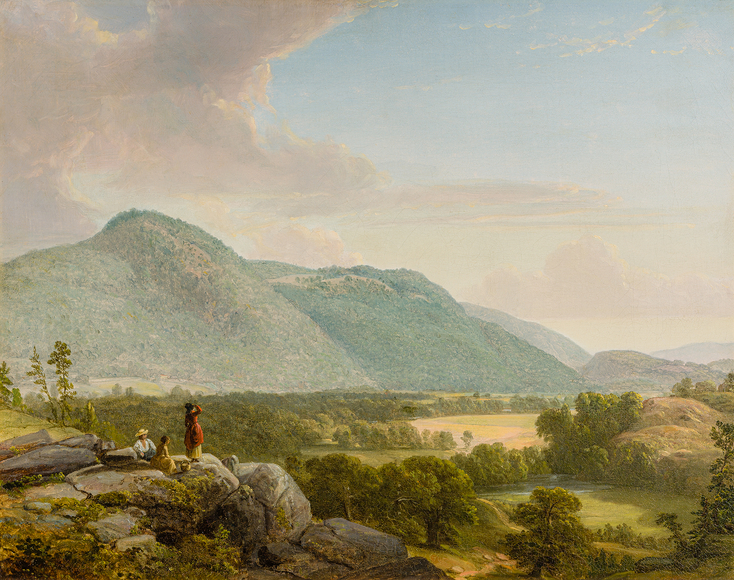
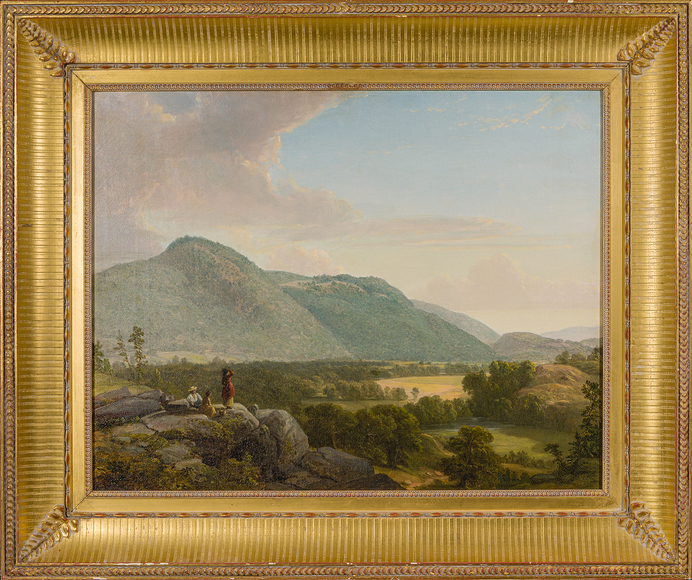
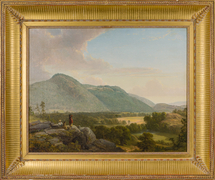
Dover Plains, Dutchess County, New York, about 1848
Oil on canvas, 19 x 21 1/2 in.
ASHER BROWN DURAND (1796–1886)
Dover Plains, Dutchess County, New York, about 1848
Oil on canvas, 19 x 21 1/2 in.
ASHER BROWN DURAND (1796–1886)
Dover Plains, Dutchess County, New York, about 1848
Oil on canvas, 19 x 21 1/2 in.
ASHER BROWN DURAND (1796–1886)
Dover Plains, Dutchess County, New York, about 1848
Oil on canvas, 19 x 21 1/2 in.
EX COLL.: the artist; to his friend, sculptor Henry Kirke Brown (1814–1886); by descent to his nephew and adopted son, Henry Kirke Bush-Brown (1857–1935); by descent to his son, James Bush-Brown (1892–1985); by descent, to his son, Albert Bush-Brown (1926–1994); and by descent in the family to the present
In 1848, Durand was at the height of his career, the dean of American landscape painters and the President of the National Academy of Design. In April 1848, he sent a large oil landscape, Dover Plains, Dutchess County, N.Y. to the annual exhibition of the National Academy. Shortly thereafter, Durand sold the painting to the American Art-Union, where, in its annual end-of-the-year lottery, it was won by a subscriber in Mobile, Alabama. By 1850, the picture belonged to Daniel Seymour, a former manager of the Art-Union, and a well-to-do paper merchant who was a neighbor of Durand’s on Amity Street in Manhattan (now West Third Street in Greenwich Village) and a fellow founding member of the Century Association. It is most likely that the painting never traveled South, since it was not unusual for wealthy New Yorkers to purchase Art-Union prizes from distant lottery winners who might well prefer a financial windfall to a work of art. Seymour arranged for John Smillie to engrave Durand’s picture for national distribution to Art-Union subscribers. Suitable for framing, the engraving found its way to widely dispersed homes across America (and sometimes even farther), becoming a staple image of mid-nineteenth-century America and, for its owners, a marker of cultural aspiration. The present painting, similarly titled, is a variant, much reduced in size, of the large painting, one of two presently known smaller views of the scene. All three differ slightly in detail and perspective. The large painting is now in the National Museum of American Art, Smithsonian Institution, Washington, D.C. The present work has descended in the family of Henry Kirke Brown, who acquired it from this close friend Durand.
The hamlet of Dover Plains lies about 85 miles north of New York City in the Tenmile River valley west of the Taconic Mountains of east-central Dutchess County near the Connecticut border. The area was first settled around the turn of the nineteenth century and grew slowly. While Durand traveled frequently to nearby areas, it is not clear precisely when he stopped at Dover Plains. Given that he exhibited his large painting in Spring of 1848, he must have been there in a recent summer. The settlement was still rural and isolated; its citizens engaged in small-scale agriculture and dairy farming when Durand visited. The neighborhood did, however, boast a regionally famous “natural wonder:”
It is situated in the midst of charming scenery and has in its immediate vicinity natural curiosities which have attracted thousands of visitors. One of these, a rocky ravine, worn deep in the mountain west of the village, whose arched opening resembles the entrance to some cathedral of mediaeval times is known as the “Dover Stone Church.” Within this entrance is a somewhat spacious cavern, roofed and walled by massive rocks, while beyond, pierced deep in the mountain, stretches a mile or two of picturesque ravine.
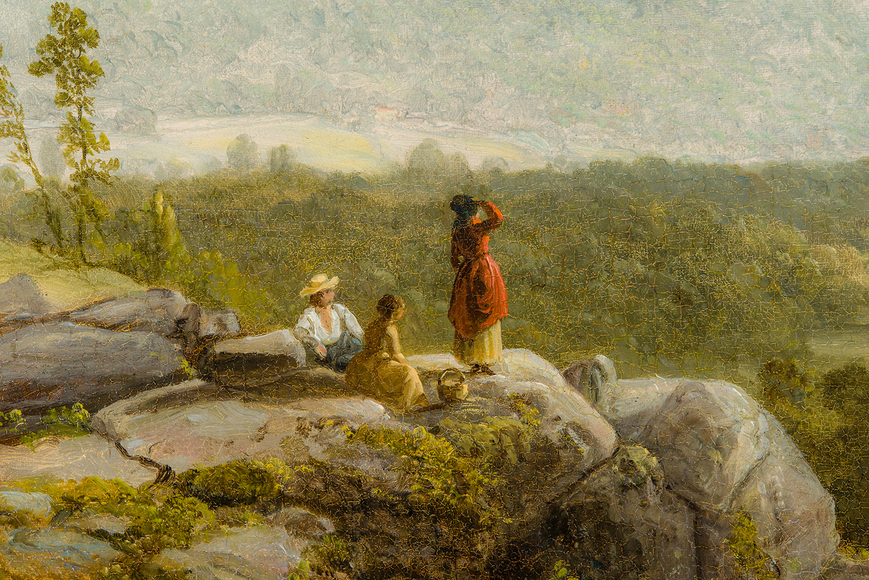
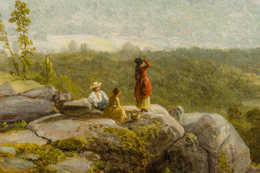
Significantly, though Durand would certainly have known of the “Stone Church,” that is not what he chose to paint. Instead, he offers a view of a modest landscape dotted with clearings, clumps of trees, rocky outcrops and nearby mountains, a view that he found quietly compelling. The three small figures atop the rocky high ground in the left foreground of the canvas are surrogates for the artist and the viewer. In both the larger and small versions, a female figure stands forward, shading her eyes as she contemplates the “charming scenery” before her. The sky is a mix of sun and cloud. Nature’s variety displays itself. Durand felt moved to record the scene is multiple versions. The artist arrived shortly before a time of transformation for this country hamlet. In December 1848, the Harlem and New York Railroad extended its line to Dover Plains. That same year two hotels opened. Dover Plains became a a scenic day trip by train from New York City.
The provenance of this picture links two major American artists of the nineteenth century, Asher B. Durand and Henry Kirke Brown. Brown was younger by nearly a generation, but like Durand, a home-grown artist who went to Europe and arrived home with a mission: to celebrate the American experience in an art form dominated by the Western European tradition, which, in Brown’s case, was sculpture. In 1846, Brown returned from four years in Europe and established a studio across the street from the National Academy of Design. Brown sculpted Durand in 1847, the same year that he was elected an Associate Academician at the National Academy. The men remained friends. A period photograph documents their relationship. Brown appears to have given the bust to Durand who kept it through his lifetime. John Durand gifted it to the National Academy after his father’s death.