
Figural

GUY PENE DU BOIS (1885–1958)
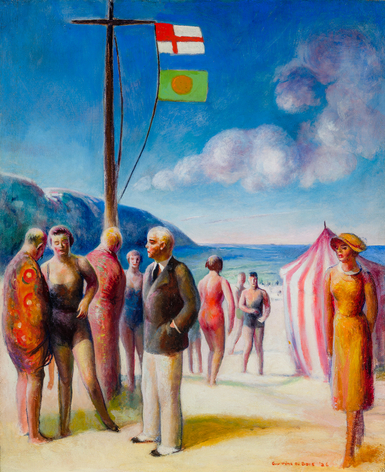
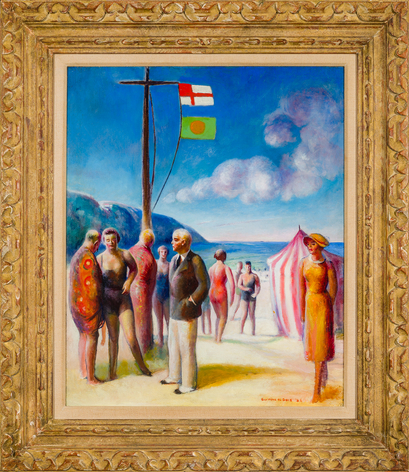
Beach at Deauville, 1926
Oil on canvas, 22 x 18 in.
Signed and dated (at lower right): Guy Pène du Bois ’26.
RECORDED: Edward Alden Jewell, “Six One-Man Shows on View as Group,” New York Times, October 30, 1936 // Betsy Fahlman, [Guy Pène du Bois: compendium of exhibition listings, chronology, and paintings], unpub. typescript, n.d., n.p., as “Beach, Deauville” // (probably) Betsy Fahlman, “Imaging the Twenties: The Work of Guy Pene du Bois,” in Betsy Fahlman and Stanley I. Grand, Guy Pene du Bois: The Twenties at Home and Abroad, exhib. cat. (Wilkes-Barre, Pennsylvania: Sordoni Art Gallery, Wilkes University, 1995), n.p. as “Beach, Deauville”
EXHIBITED: Kraushaar Galleries, New York, November 11–18, 1936, Exhibition of Paintings by Guy Pene du Bois, no. 1 // Graham Gallery, New York, November 19–December 14, 1963, Guy Pene du Bois 1884–1948: Paintings of 20 Younger Years, 1913–1933, no. 29 // Parrish Art Museum, Southampton, New York, July 10–August 2, 1964, Guy Pene du Bois, 1884–1958, no. 33
EX COLL.: the artist; [ACA Gallery, New York]; to private collection, 1965, and by descent in the family, until the present
In mid-December of 1924 Guy Pène du Bois and his family set sail for France on the steamship Rochambeau. After years of juggling teaching and writing with his artistic pursuits, Pène du Bois now had the means to focus his time exclusively on painting. Upon arriving in Paris, he fraternized with fellow Americans, among them the sculptor Jo Davidson, and frequented artists’ haunts such as the Café de Dome in Montparnasse. Nevertheless, aware that the charms and excitement of the City of Light might be distracting, he ultimately decided to headquarter his family in Garnes-par-Dampierre, a tiny village of about one hundred people situated in the Valley of the Chevreuse about 25 miles outside of Paris, not far from the larger municipality of Senlis.
Garnes was a perfect choice for an artist seeking a quiet and affordable place to work in the country. In the beginning, Pène du Bois rented a small furnished house where he set up his studio. However, when two additional family members arrived shortly thereafter, the artist realized that he needed more space. Pène du Bois subsequently settled into a larger residence (nicknamed the “Mason Bois”) with an adjoining two-and-a-half story stone barn that would serve as his workplace. Pène du Bois quickly embarked on a period of prolific activity during which he refined his signature style. Imbuing his Art Deco forms with a greater degree of stylization than in the past and working on larger formats, he refined his technique, interpreting his figures as sleek, firmly rounded shapes that have often been described as “tubular.”
During his years in Garnes, Pène du Bois made regular train trips back to Paris, where he continued to enjoy the company of visiting American artists and, as was his practice, to make sketches of the fashionable people and other interesting types he encountered in cafes, restaurants, museums, and popular venues such as the circus. Back in Garnes, he translated these vignettes into easel paintings, among them classic examples such as Café du Dome (1925–26; National Gallery of Art, Washington, D.C.). However, the French capital was not the only locale that provided the artist with motifs for his brush. During the August holidays, when Parisians typically headed to the “Normandy Riviera” for their annual vacation, Pène du Bois and his household followed suit, spending the month in Villerville-sur-Mer, an unpretentious hamlet not far from the upscale resort town of Deauville. There, and in neighboring Trouville, Pène du Bois encountered “loads of my kind of subject matter." As he wrote to John Kraushaar in August 1925, “I’m getting crammed with subject matter here—beaches and tents, casinos and gambling with faces leering over greentables, hard-boiled faces, pudgy diamond loaded hands, thin-faced stoics.”

