
Still life

WILLIAM MICHAEL HARNETT (1848–1892)
A Gentleman’s Study, 1881
Oil on canvas, 28 1/8 x 38 in.
Signed and dated (at lower right): WMHarnett / 1881 [initials in monogram]
EX COLL: private collection, Germany; by descent in the family, Wiesbaden, Germany, 1957–2025; to private collection, New York, 2025
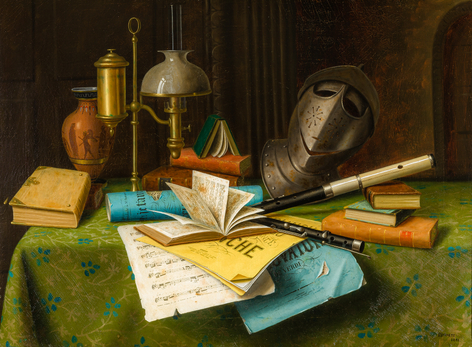
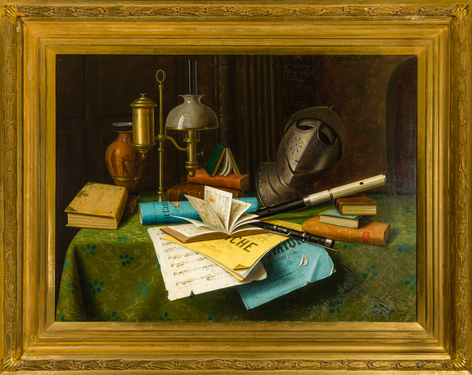
With its signature sheet music and the artist’s own flute, a lamp, a vase, the helmet of a suit of armor and a scattering of finely bound books, A Gentleman’s Study takes its place as an iconic signature work of the American master of still-life painting, William Harnett. Painted in Germany in 1881, A Gentleman’s Study remained there, privately held and out of sight, until 2025.
In 1880, William Harnett paid his own passage to Europe with the carefully husbanded profits of a modestly successful four-year career in Philadelphia. It was the obligatory artist’s journey: to visit, to study, and to learn from everything the Old World had to offer. Harnett intended to support himself in Europe, as he had done in America, by selling his paintings. During four and a half years in Germany, Harnett found, as he had hoped, a ready market for the tabletop still lifes that had already attracted patrons at home. “I did very well,” a pleased artist told an interviewer in New York around 1890. “I sold pictures to American travelers; Germans, Frenchmen, and even Englishmen....” A Gentleman’s Study was likely one of the fruits of a happy circumstance that jump started Harnett’s career in Germany.
A Gentleman’s Study dates to 1881 when Harnett’s skills were at their peak. The picture bears witness to the artist’s extraordinary ability to render complex objects with exacting realism. Here Harnett includes a flute, a student lamp, a vase, and a helmet from a suit of armor, in addition to multiple books and copies of sheet music. Some of these objects are familiar friends. Harnett was a dedicated amateur flutist and the instrument in this picture is his own, appearing in numerous of his table-top compositions. The lamp on the table, called a student lamp, was a popular reading light in the late nineteenth century and manufactured both in the United States and in Germany. The helmet is the kind of curio that would have been much more readily acquired in Europe than in America. Harnett frequently reused the same sheet music in different compositions. These were likely was part of his traveling gear, along with his flute, allowing him the pleasure of music making during his time in Europe.